Tuesday, 27 August 2013

Jon Horner

You'll know Jon Horner's work already, if not from his Sleeping In The Dirt comic strip Sidewalk magazine then perhaps from his monthly strip in Thrasher, or even his comic in music-nerd bible Record Collector. It could be that you know his art from the boards, t-shirts and wheels of John Rattray's lifestyle/streetwear super-brand The Predatory Bird. Howsoever you've been touched by Jon's wit, penmanship and imagination, you can be assured that everything he draws, he draws for fun - truly a skateboarder's approach to art. Without ever having to dabble in the dark art of self-promotion, Jon's cartoons and caricatures have found their way into magazines and skateboards here and across the Atlantic. With his profound knowledge and appreciation of skateboard history and Alan Partridge, we're lucky to have him - and since he's one of the most humble people you could meet, we were even luckier to get him to agree to this interview. As you'll see, we're very glad we did. You can find vast amounts more of his work here and here.

Jon Horner by Andy Smoke

What's your art background? Did you study art, design, graphics..?
I've got an art GCSE! That's it as far as 'formal training' goes though. My training was years spent copying things from the Beano and trying to draw the Thunderbirds.

When did you start skateboarding?
Around 2001ish I think. It was in the Tony Hawk boom. My brother skated and it looked like fun so I got a Hudson complete from JJB Sports for £20. The board had been shrink wrapped before the trucks were attached, and as I didn't know how to take the trucks off I spent hours trying to pick all the little bits of plastic out from around the bolts.


Did one lead to the other?
Not really, but it definitely helped keep my interest. I'd spend longer looking at shop adverts than the photos in skate mags. Looking back I guess it was the tail end of the hand drawn cartoon graphics boom, World and Blind had been sold but Marc McKee was still doing incredible drawings for them. Flip had some incredible graphics then too, it probably helped that most of their team were basically cartoon characters.

Mark McKee kind of dropped out not long after that, what other skateboard graphic artists did you get into? It maybe wasn't the most obvious era to be inspired by... Did you start getting interested in older stuff? You seem to have a pretty vast appreciation of the history of it all.
Enjoi was just starting back then, I think Marc Johnson was doing the art, there were a lot of Saul Bass inspired graphic s that were great, the Heroin illustrator series were always amazing too. As far as particular artists go, at the time I had no idea who actually did anything! The internet was like a little broken down hutch compared to the vast rabbit hole it is now so there wasn't really a way that I knew of to find out who actually did anything, or really to find old board graphics. Document used to interview artists, so that was always interesting. I remember trying to copy one of the drawings in the Jamie Bridson interview.


What's your day job?
I was hired to design a range of children's characters. Basically, my job was to invent the characters (how they look, what they're like, their world etc) and to work with other people on making toys, computer games, books and that sort of thing. The project is still relatively new, I've been working on it for about a year now and it's starting to come together. It's beginning to go from ideas on paper to actual physical things. Before that I worked at HMV. 

Do the people at your work know about your other life as a skateboard illustrator?
Haha, yeah! The day job's only part time and I work from home so as long as everything gets done it's all good!

'Where's Penny'. Click for bigger and more.

How long did the 'Where's...' posters take? I imagine you sitting up for nights on end surrounded by hundreds of magazines - was it like that?
They took forever! I don't really want to know exactly how long because it will probably just make me miserable. There were a few magazines but mostly it was just finding things online. I watched a lot of old videos on YouTube and logged an obscene amount of hours scrolling through the Chrome Ball Incident. That was the fun bit. Mostly they came together gradually over time but there was one all-nighter. When I did Where's Chin it was just one massive drawing on 9 sheets of A4 paper held together with sellotape so the whole thing was pretty precarious. I was moving flat and I wanted to be able to take it apart before I moved it so I stayed up all night surrounded by boxes listening to the Tina Fey audio book (which is excellent) and drawing.

What medium do you work in?
The most basic one! I plan things in pencil on cheap A4 paper, go over them with drawing pens, rub out the pencil marks, scan them and colour them in with MS Paint.


Rejected Factory Sleeve Designs. Click for bigger and more.

What artists do you rate just now?
Andy Smoke, obviously. 'His Board Had No Pop' is one of my favourite things (it's at littleliedown.wordpress.com). Everything Mike O'Shea does is amazing. There are loads of people! Phil Morgan, James Jarvis, Ryan Salter, Paul Parker, Pete Fowler, Rob Mathieson, Mr Gauky... I could probably go on for a while...  

Would you be doing what you do now if it wasn't for Gilbert Shelton?
Ha, I was never that into Shelton, his art is always great though. When I was younger it was the Beano, Thunderbirds, Asterix and Wallace and Gromit then the Simpsons and later I discovered underground comics and got very into R Crumb, Peter Bagge, Joe Matt, Art Spiegelman, Harvey Kurtzman, guys like that. Basically, anyone who draws properly and writes funny stories. Life's too short to read turgid crap about feelings. Although, having said that, Chris Ware is incredible. A bit of melancholy is fine in his hands.

 More Man Cat here.

Loads of boards get re-issued these days. Do you think that's because the graphics were better then? Rather than just logo boards...
Hmm. Maybe. I don't know if anyone will ever be as good as Sean Cliver, Marc McKee and Jim Phillips, they were the right guys in the right place at the right time. And it's true that some companies put out some awful rubbish these days (and not just logo boards), but there are still amazing new graphics coming out all the time. I think the reissue market is a lot more to do with nostalgia, there are a lot of men 'of a certain age' who have glowing memories of happy childhoods when skateboarding was all that they cared about. Now they have jobs and mortgages and responsibilities and reissued boards let them buy back a little piece of that glow and hang it on their wall. I totally get it, I bought a copy of the first Beano I ever owned from eBay! Also, it's probably pretty helpful financially for certain companies who's years of relevance are in the past.

Alan graphics.

Magazines have always been a big part of the skateboard aesthetic. You must love magazines.
I'm such a sucker for actual physical things you can pick up and hold in your hands. Obviously it's pretty indisputable that in many ways the internet is 'a good thing' and as a method for distribution it's incredibly exciting. But as a medium for holding the written word, photographs or comic strips I don't think anything will ever be able to beat a piece of paper. Going back and flicking through old magazines is so evocative of a time and a place in your life, and that ability to go back and wallow a bit is something that's much more difficult online with the constant screaming emphasis for the newest, most excitingest shiniest thing. I really hope the days of the printed magazine aren't numbered. I never had much access to American magazines aside from a few issues here and there, but between Sidewalk and Document we've always been pretty well catered to over here.

 A strip Jon did, featuring characters by Andy Smoke, and based upon the Bite My Wire interview with Jereme. Click for full size.

How did you come to work with Sidewalk, and how did you come to work with Thrasher and Record Collector?
Andy Horsley changed my life. After finishing uni there weren't really any 'proper' jobs around so I decided I had nothing to lose by just doing the thing I most wanted to do rather than something I thought would be more obviously useful in the quest to be employable. I'd tried being a journalist for a while, and it was fun but my heart wasn't really in it, although I did get to review the film 'Mega Shark vs Giant Octopus' for Time Out. That's a film about which dissertations should be written. It was also really hard to find anyone willing to pay real money, so I figured if I wasn't getting paid anyway I should be getting paid nothing to do what I really wanted to do. 


What I really wanted to do was make comics, so I made one. At the time I was horrendously naive over-ambitious, so I planned out an eleven part epic called 'Gentlemanly Conduct' about a UK skate team on tour in 2002. It was vaguely inspired by the Vans 'No Home Comforts Tour' video, which is one of Andy Evans' many masterpieces. About six months after starting work on it issue one was finished and I sent it out to pretty much every magazine and skateboard company I could think of. Andy got back to me and started giving me bits and bobs to do and it went from there. There was a Big Push DVD cover, some stuff for the Buyer's Guide and the regular strip. The pitch was 'It's like Lost, but with the history of skateboarding'. As I result, I've been making it up as I go along. Getting work from Sidewalk was the first thing that really made me consider illustration as a thing that could potentially be a job, so I started looking for part time work to subsidise my hours spent drawing. 
The Thrasher connection is all John's doing. He sends me a script, I send him a comic and he has all the dealings with them. 

 
Bob Dylan Supervillian. Bigger and more here.

The Record Collector strip came from a comic I wrote with my brother called 'Bob Dylan Supervillain'. He's a massive music nerd and a musician himself (look for Syd R. Duke on YouTube) and we wrote this ridiculous strip about Dylan going electric with the help of Allen Ginsberg to fight Mr Tambourine Man. It was originally written with the Stool Pigeon in mind, they had a great comics section, but when we never heard back from them I sent it out to a few magazines just out of curiosity. Record Collector got back in touch saying they didn't have space for a full page comic strip every month, but asked us to pitch a few ideas for shorter strips. We did, they liked them and it's gone from there.

Was the Crayon board pre-Predatory Bird? How did that come about? Did you skate the board yourself?
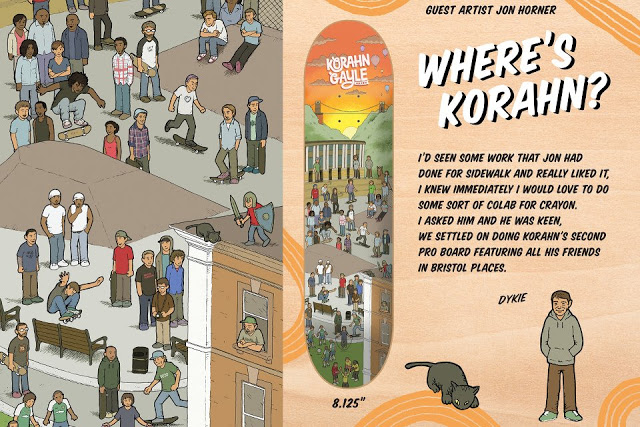
That was a direct result of the 'Where's Chin' poster. Dykie sent me an email and it was his idea to do something similar but with Korahn and his friends and famous Bristol spots. I was so stoked to be asked, Korahn is an amazing skater and Crayon have some serious heavy hitters doing graphics for them, so to even be considered was amazing. I didn't ever skate one myself, it was a bit wide for me! Having someone make something you've drawn into a skateboard is the best feeling. 


Do you art types all hang out?
Andy and I have regular important high-level executive business meetings to discuss implementation strategies for Class IIB. These often take place at the kerb bit at Clapham skatepark, the crusty old banks at Royal Oak or in the pub. 

You drew up a rad graphic for the new Blueprint. Do you think they should have ditched the spray hearts or do you reckon it's a legacy the new guys should keep up?

I'm trying my best to get hired by Bizarroprint. No luck so far though. It's all a bit sad what's happened there, isn't it? Everything I know about exactly what happened comes from internet rumours and hearsay (Myleene loves industry gossip), but it seems like the brand's been in a bit of a tailspin for a little while due to various factors and now it's crashed down to earth in the Canadian tundra. I suppose it's a good thing that what Dan Magee and Paul Shier created was seen as worth saving, but this lumbering dreadlocked Frankenstein's monster is fast becoming a cruel and incontinent taunt to the past.


In a way, maybe it's exciting that Britain can add a brand to the Blind/World legend of companies that were once great and are now a bit awful, but it must be pretty horrendous for Dan that they've not mixed up the graphics a bit. I mean, aside from the always incredible team, the first thing that Blueprint brings to mind is an aesthetic, and as far as I can tell, that was entirely deliberate and all Dan's doing. It must be pretty grim to see something you've worked so hard at and poured so much of your soul into being hacked up and shuffled about and slapped with a rasta colourway. From the graphics I've seen so far, and particularly that monstrosity of a cruiser board, it's like they've got all the pieces but they don't quite understand how they go together, why they would go together and why anyone would even want them to in the first place. But stick them together they do, with all the artistry of a drunk assembling an Ikea bookshelf. 
But maybe it's a good thing. I think we can now all agree that Blueprint is no longer worthy of our attention, and perhaps that will give some other UK companies a bit of breathing space. Now that the Death Star has been blown up, the ewoks can all dance around a bit. If the decline of Blueprint was in any way responsible for the birth of the National and the existence of those RA Brown painting decks then it wasn't an entirely bad thing.


Triangles in 2013: Post-post-modern, or tired and tedious?
I've got a theory about Palace and it's quite highfalutin (which is just a pretentious way of saying pretentious).
Plato had a theory that everything has a form. I tried explaining what this means in my own words but it wasn't working out so I'm going to do some route one philosophy student work and copy and paste from Encarta:

"Forms are the essences of various objects: they are that without which a thing would not be the kind of thing it is. For example, there are countless tables in the world but the Form of tableness is at the core; it is the essence of all of them. A Form is an objective 'blueprint' of perfection."

My theory is that Palace is incredibly close to the form of 'Palace skateboard company'. It seems like every single decision that they make is made on the basis of 'is that what we want to do?'. It sounds obvious, but it's pretty rare that you don't see something that's been second guessed in some way, whether it's to try and broaden its appeal and shift more units or to take the edges off an idiosyncratic idea that might be unpopular or controversial. It's especially rare in a company that's actually got popular and successful. There seems to be no great strategy in place at Palace other than, in the words of Nuit, "Do what thou wilt shall be the whole of the law" and I think that's pretty admirable. 
Having said all that, they're so tempting to make fun of! As far as I can tell, there are two main reasons for that. Firstly, they've got a really strong graphic identity (and rest assured I hate myself for using that phrase) which makes them easy to parody because it's very straightforward to make it clear that what you're doing is a Palace reference. And secondly, they're massively beloved of Sugar Ape readers who are nature's easiest and most deserving target.

John Rattray bonus!


Hello John. Tell us about Jon.
Jon sent me, via Gmail, an illustration he did, fully finished and coloured, of Carl Weather's character Dillon, from Predator. The illustration depicted Dillon, screaming on his knees on the jungle floor, his arm, severed at the shoulder is being carried skyward, assault rifle still blasting, by a bold and ravenous gull.
The accompanying note said, "I've been very much enjoying the blog lately and in a moment of inspiration(?) I drew this. It's yours if you want it."
I did want it. This was the greatest piece of unsolicited mail I've ever received. So far it's a tee shirt.


Not long after that, on Instagram, he posted a picture of some graphic ideas with portraits and quotes from Bertrand Russell, Hunter S. Thompson, George Orwell and Kurt Vonnegut. I hit him up about the fact that these should be somehow manufactured. It's a project that remains unrealised - as lots do - but it showed that we were on the same page as far as heroes go.

Anyway, a couple of weeks after that there was some news coverage of Dutch artist Bart Jansen's taxidermied cat helicopter. Jon posted a picture of that and I commented that "I just can't tell if I really do like that or not", I've still never double tapped that image. Jon replied, "I know what you mean. It's the expression on his face that sways it for me. Plus, he was named after one of the Wright brothers. And it would be really fun to take it to Trafalgar Square and blow some pigeons minds." He was selling me on the idea that although morbid, it was also awesome. I already knew morbid things can be awesome from growing up watching Evil Dead and listening to the drum check with Pete Sandoval skit. I told Jon that "it certainly adds a new dimension to the whole predatory bird thing". That's when he suggested, "The villain in The Predatory Bird comic would fly around in this".
"You make it and I'll sell it and this time next year we'll be millionaires!" I said. I've never been sure if he got the Only Fools and Horses reference there but he did agree that "Unimaginable riches surely beckon".
That's pretty much it. We've been collaborating on this comic story since then. We email and occasionally Skype to talk about it. It's been a lot of fun, Thrasher's been running it and hopefully we'll adapt it into a little stand alone thing at some point.


Andy Smoke Bonus!


Jon and his pal Andy Smoke are both managing directors of the UK's leading skateboard sticker company, Class IIB. Dismantling the snobbery of the skateboard industry one adhesive at a time, their limited edition collaborative cartoons can be admired (and purchased) here: http://class2b.bigcartel.com/ You might have seen Andy's drawings illustrating our Bite My Wire music page, you might remember the board graphic he did for rooftop-preacher and self-confessed sexual superhero Jereme Rogers, or you might even have noticed the excellent drawing of Jon he knocked out to illustrate this very interview; so we asked Andy about his mate. Andy's drawings, photographs, mixes and other art can be found here.


How do you know Jon?
I met Jon through a mutual affection for Clockwork Orange banks and the Beano. I think Class 2B was born out of skating the bottom step of Southbank 7 one day. And anyway, having drawings printed up into stickers rules!

Congratulations on getting a drawing on a Jereme Rogers board.

The Selfish graphic competition was funny - the other entrants were excellent. I'm still amazed the boards ever saw the light of day. J Cass may be manically insane, but he put one of my drawings on a board. Stoked!

How did you get into drawing?

Alex Moul was getting a lot of coverage in the first magazines I bought. Moul was on Deathbox then - a company that inspired not only with their skaters, but with their twisted cartoon graphics. New Deal and World were also making great graphics - I'm still stoked on Marc McKee and Sean Cliver's art. Needless to say, I was hooked.

And how do you go about it?

Most of my stuff starts with an idea in the bath, followed by a damp paper sketch. Sometimes drawings get completely re-worked in Photoshop; other times they get inked and coloured by hand.

Monday, 5 August 2013

Mat Fowler and Spillage Fete Records

From his part as co-producer of pivotal UK skate video Playing Fields to his current role as a graphic designer with Playarea (sharing an office with legendary UK skate photographer Wig Worland, no less), and running a boutique independent record label with his friend Matt Hunt, it's fair to say Mat Fowler likes to keep himself busy. Since curating the first Blank Tape Spillage Fete event in 2006, the exhibitions have evolved into Spillage Fete Records, one of the most interesting labels - or communities - straddling the boundaries of art and music today, with artists/exhibitors/musicians all being encouraged to provide music, artwork and performance on their own terms. The DIY label releases beautifully experimental other-worldly music on vinyl, cassette and sometimes even CD, packaged in (and amongst) some very fine artwork; recently The Wire magazine described the label as "a delightful outpouring of outsider audiovisual art" while The Guardian declared it "A lo-fi celebration". Mat gave us his time to tell the story.
 

Mat Fowler's Playing Fields section, 1997

What did you do after Playing Fields? It must have been such an all-consuming task, what did you do afterwards? Were there other projects you could move on to, or did you take it easy?
Playing Fields was the last independent skate film I was involved in. Three years before that, myself, Mark Channer and Mike Manzoori made a film called Jello. All three of us had just left school and were studying at Amersham College on the outskirts of London, I was doing art while Mark and Mike were studying film and media. We hand duped around fifteen VHS copies and distributed them very carefully! I think Ben Powell might have the last copy left standing, my own nurtured mold in my cellar under the house! Jello documented some great footage, especially of a very young Tom Penny and Toby ShaulI. I continued skating up until my late twenties, at which point I became self-employed and starting creating design work under the name Playarea. Being self-employed allowed me to start focusing on my design work as well as playing music which had become a real passion since easing off skateboarding.

Did you feel you'd reached a bit of a peak in skateboard film-making with Playing Fields? I don't know where you could have gone from there anyway, it was quite 'defining'.
Looking back it definitely felt like a journey, a one-off project, at least for myself and I think for Ben, Mark and Frank also. My mum had passed away that same year and being involved in Playing Fields, spending time and forming bonds with Mark and Frank really helped me through a challenging time in my life. When it came to editing, I was interested in the final film, but the year spent making it was an incredible time where I had the privilege to meet some great people and get to know our small Island that much better. I met up with Frank recently to pass on the original master tape of Playing Fields - which had been in my dad's garage for over fifteen years - and it was so good to see him, he's still killing it on a skateboard!
                     
'Snowsteps', by Bons

How far down the line did the idea for a label come along? Was it always your plan to take such time and care with the music you released - and its presentation - or was that a by-product of the artists you ended up working with? Tell us about it.
The 'Spillage Fete' record label was a result of a pipe dream both myself and musical collaborator Matt Hunt dreamt up called 'The Blank Tape Spillage Fete'. I had becomes friends with Matt while we were both studying at Norwich Art School and when we eventually moved back to London we shared mix tapes and started recording music together under the moniker of Bons. Both myself and other Matt loved the warm, and sometimes unpredictable, sound quality of tape and the four-track was our own weapon of choice when it came to recording. So we came up with an idea for an sound/art exhibition based around our passion for the cassette.
We invited musicians making art - and artists making music - to compile and create their own musical/sound material and record it onto a cassette tape, then asked them to produce the artwork to accompany their cassettes. The brief was left intentionally open, leaving the participants to explore all musical possibilities as well as creating artwork that could transcend the plastic cassette case. The varied and eclectic contributions formed the content of the first Blank Tape Spillage Fete exhibition at the Cecil Sharpe House in 2006, where visitors could listen to the cassettes at individual listening posts whilst also being able to peruse the artwork. A week long exhibition culminated in an evening of performances from selected participants. The project was a happy success for everyone involved and we ran a second exhibition with new contributors in 2009. These contributors included Luke Abbot, David Thomas Broughton, Sue Tompkins, Luke Fowler, Kirsten Ketsjer, Mike Lindsay of Tunng, Mac McCaughan from Superchunk, Merge and Half Cousin. After the two exhibitions it seemed a natural progression to release music by ourselves and people closely involved with the Blank Tape Spillage Fete projects. The name 'Spillage Fete' pays homage to the eclectic sounds of the fete, the spills of the tape, but also to emphasise a village community spirit of people making and doing.

Contributions from Luke Abbot & Marcus Oakley for the Blank Tape Spillage Fete exhibitions.

What about the other events you do?
Since the exhibitions we held in 2006 and 2009 we've also curated a number of evenings showcasing a line-up of artists who have released on the label or taken part in the exhibitions. Due to the often organic nature of these 'happenings', we label these gig nights as Spillage Fete 'Occasionals'. We've also released our first publication under the same name - 'Occasional' - which features artwork from label artists and a sampler CD.

It's a beautiful artifact, yet very few people will see it. Would you consider doing bigger runs, or do you like that it's so limited?
I think for us the small runs are almost a necessity, cost being one reason and the other is actually getting the things we make into the wider world! We don't run the label through any distribution agents, we do it all ourselves, so our market is pretty niche, at least for now. Doing limited runs also allows us to hand customise releases which we could never do if the quantities were really high. The artifact is really important to us, there is so much 'stuff' in the world, that we hope our time, effort and goodwill puts something positive out there.


Harry Deerness live recording

Do you think skate videos today have such longevity, what with file sharing and so on? Would Playing Fields have ended up such an important part of UK skateboarding if it was released on iTunes? You obviously value the physical artifact, rather than things existing just on a hard drive.
I never thought about that, interesting. Since Frank Stephens is re-releasing Playing Fields on behalf of all of us this year, I think he would have more to say on this topic, now having to reconsider the best options to get it out there in a digital age. Although a fan of physical artifacts, I think it would still have the same impact, mostly due to the collective and community driven feel of the film. It encompassed and documented the whole UK skate scene at that particular time and did so
with the pure blind faith, positivity and good will of everyone involved, void of money or sponsors. But yes, I am interested in the artifact and document, especially within music. It feels like archeology to me when rifling through record racks, and I think the artwork chosen to represent someone's music is equally significant and intriguing.

A Blank Tape Spillage Fete listening post

Could the aesthetic of modern skateboard videos ever match stuff like the old Powell videos? Or the first three Alien Workshop videos? Can that be replicated these days?
That's a hard one to say, I'm not up to date with modern skate videos but I should imagine that people could create films to rival those old classics. I think it's hard though, as skateboarding in those old Powell days was at such an early stage that those videos were introducing huge leaps in what was physically possible on a skateboard, as opposed to variations on existing tricks. Although I do think the accessibility of modern technology, like phones and internet combined with cine, Hi-8 and video could create some really interesting results. I'm interested in using 'generic' mediums in unique ways, there's a lot of potential and things seems to be really opening up.

Do you see parallels between self-producing a skateboard video and starting a DIY record label? To an extent both are based on hard work, little reward and trusting others to perform...
The motivations are definitely similar, with Playing Fields and Spillage Fete, and
the emphasis was and always will be the process of creating and releasing something you feel is both positive and authentic. When we made Playing Fields we were unsponsored, signing on and using affordable low budget Hi8 cameras, we saw it as an opportunity to create a complete scene video without any bias from the skateboard industry. The limitations of both money and equipment were often more a catalyst for creativity and ingenuity than a hindrance. The label runs off not such a different philosophy, the rewards being the creative process, the journey involved and the relationships that follow. Both myself and Matt work full time and the label runs parallel to this, it's self funded and all sales go directly towards future releases. Most of the artists and musicians involved in Spillage Fete are friends or extended family met through the Blank Tape Spillage Fete exhibitions we curated. Kevin Cormack - aka Half Cousin - is a musician we originally approached to take part in the BTSF projects, since then we have put out two wonderful releases by him, one being a mini album under his Half Cousin moniker and a second titled Harry Deerness, a psychedelic celebration of decay.

Why do you think so many skateboarders eventually move into creative industries?

Skateboarding really teaches you to pay attention to your surroundings, 
to really look and observe, then from this to make creative marks. I feel this is more relevant to street skateboarding than park or ramp skating; street skating was so much about exploration and curiosity, questioning the landscape and architecture, making it submit or release some untold secret that would otherwise be held in its everyday functionality. I remember first seeing a sequence in RAD magazine of Ged Wells doing a wallride just off the flat, and I found it hard to believe. It made me rethink the realms of possibility, and not just on a skateboard.


Half cousin

You've mentioned enjoying the feel and sound of cassettes, but why do you think DIY and cassette-culture is enjoying such a comeback just now? Ultimately, it's a very impractical medium.
That's an interesting one, the cassette tape was the first format of music I bought when I was young and the only medium
I've used in recording my own music, so although I know they are considered a retro format, to me they feel very normal.
From my point of view the cassette and four-track is a cheap and tangible home recording method. I like the limitation of having only four tracks and no computer after effects, as it's really forced me to dig deeper and uncover new sounds, textures and processes. And of course I love the natural warmth of sound that tape attracts. I think perhaps it's had a comeback as there are a whole generation of new music makers who are new to analog recording and are curious to explore, which is exciting as they will have a totally different approach to using the medium having grown up in a digital age.

Do you see this as something that's growing, developing out of just being a niche? A lot of people are deleting their facebook accounts, going back to old phones, that kind of thing. Do you think technology has gone as far as it needs to for now, and would you encourage people to embrace techniques used for decades rather than trying to keep up?

Wow, that's a good question, and it's something I think about a lot. I'm fortunate to have grown up in a time without the internet and computers. I feel this places me in a position to observe and use the technology as a tool, but not become 'plugged in'. I don't have internet or email on my mobile, for me it's a distraction from engaging with the life around me and it just suits me better. I think technology will always be pushing forward and it can be wonderful and useful for creating, but I value imagination and curiosity far more. Whether it's four-tracks or computers, either way I'm interested in scratching beneath the surface. When I make music, it feels like lifting pebbles in rock pools, that same excitement, trepidation and discovery.

'The Occasional', the Spillage Fete publication

Describe the music you put out on the label.
That's a tough one! Generally we're attracted to - and release - music that somehow fills the grey-areas between genres and styles. I've always loved the records that become definable by being almost unclassifiable, the ones you've never heard of, but are drawn to in the record racks by their curious covers. Both myself and Matt invited musicians to take part in the BTSF whose music we'd discovered through years of second hand record shopping. Some of these records being the unknown gems of our collections, prime examples being Half Cousin's Function Room and Position Normal's Goodly Time albums. We like the label to have that same diverse feel, to echo the eclectic and experimental nature of the exhibitions.

You discovered Half Cousin through second hand record shopping? That's really cool. Was it easy to get him involved in the BTSF stuff, and get two full length releases out of him?
My friend Matt first introduced me to Half Cousin, he would make me the most incredibly obscure mix tapes, and one featured a few tracks off the Function Room album. Following this, we both went to watch a Hood gig and Half Cousin played support and blew us away! After one of his gigs we passed him an invite to contribute music to the first BTSF exhibition and he kindly obliged with a track titled after fellow Orcadian George Mackay Brown. Since then we have become great friends, sharing a similar aesthetic and collaborating on musical projects. Myself and Kevin - Half Cousin - are collaborating on a project called Jam Money, which is recordings I've made to four-track then re-recorded onto Kevin's four-track for him to work with.


How did Spillage Fete move from being an idea to a fully formed label/project/community? How did the first few months of it shape out?

In the words of my fellow cohort, Spillage Fete is a slow burner!
We started it with a viewpoint to creating something that both ourselves and - hopefully -
other people would enjoy being involved in. We see it more as a community or vehicle for friends to create and release interesting music and art. So releases on the label generally only happen as and when they are fully realised and ready for the world, no deadlines or schedules. One release that has been threatening to grace the record store shelves is Medallions by Bons; a collaborative album by myself, Matt and a sound artist called Benji Fox.
Our original recordings made using four-track, keyboards, guitar, pedals, voice and percussion have been reappraised and removed from their analogue context, then reconstructed, destroyed, tampered with and ultimately redefined to create a curious bedroom-pop-post-punk assemblage. All being well this should be completed and out by end summer, there is a taster on our site!

Would you recommend building a project like Spillage Fete to the curious creative types out there?
Without a doubt; creative projects are a rewarding and healthy release, be it music, art, writing or anything else. And involving and engaging with other artists in a community based project really expands, colours and feeds you imagination.

Outside of Spillage Fete stuff, what are you listening to just now?
Maher Shalah Hash Baz, Flaming tunes, Tall Dwarfs, Dustin Wong, The Books and Broadcast to name just a few.


More to listen to at the Spillage Fete SoundCloud

Get all the info at spillagefeterecords.com

Thursday, 4 April 2013

Karl Bartos

Karl Bartos was a member of Kraftwerk during their most iconic, productive era. As the band's classically-trained percussionist an co-writer, he had a massive influence on the sound and direction of Kraftwerk, and ultimately - through records like Trans-Europe Express, Man Machine and Computer World - on the advancement of electronic music and how we know it today. Since leaving the group in 1990 because of the continuing slow creative process brought on by the band's perfectionist approach, Bartos went on to release a number of solo albums, work with Johnny Marr and Bernard Sumner in their band Electronic, produce music for others and even release the Mini-Composer iPhone app - which is a lot of fun. His latest album, Off The Record, draws from material he has gathered from the last 35 years of his life and is out now on Bureau B.

Atomium-headed Karl illustration by Andy Smoke.

So I understand that this new album is made up of pieces of a 'musical scrapbook' you've been building up over the years. If that's the case, does the record reflect more on where you are, musically, now or at the time you had the idea?
Hopefully the result is the best of both worlds! When my label approached me, they said "Hey Karl, haven't you got any old tapes in the attic?" I refused, but they kept asking me and asking me, and they just wanted to put these old tapes from the attic out. Finally I got convinced by the idea, and I transferred all my old tapes from my archive into the computer. When I saw all the dates, 1977, 1978, and so on, it looked like a kind of 'acoustic diary'. It wasn't meant to be an acoustic diary but it became an acoustic diary by seeing all the data. Once I transferred it into the computer it was easy for me to just put bits together, and I did what we call recontextualisation. It's easy to recontextualise material on the computer! I took these bits, these jottings, from here and from there, and they were not real compositions, but just jottings. Some of these scribbles I took into a place called Kling Klang studios, and they became rather famous. Some of them, I didn't. Some of them I took there and they seemed to be a misfit, or they just didn't belong to the current record. Unfortunately, we made so few records at the time, in the 70s and 80s! So I ended up with this encounter. Karl Bartos that I am now, with this youngster, this whippersnapper from the 70s and the 80s. So I could combine this naivety which a 20-something guy has, with my experience now, which led to this record that is in our hands today.


Was it easy to recontextualise the old stuff with modern technology? Bearing in mind you weren't writing all that stuff with modern technology.
Exactly. This is as developed as we can be, having a computer to splice these things together. In the early days you couldn't make an archive, and technology wasn't as accessible as it is nowadays, so it was a great help. It's a complete mash up actually, of the technologies from the 70s and 80s, and nowadays technology. So again, the best of both worlds. This record couldn't have been done in the 70s or 80s.

When you were in Kraftwerk, you were having to develop the technology to make music yourselves. Now anybody can make music on their computer. Do you think technology has affected people's creativity?
Yes, of course. The medium is always responsible for the content. It won't affect me, because I did my piano lessons when I was young, I played in an orchestra and I played guitar. So I use technology as a tool. But certainly, if you take your first steps in making music when you open up a computer and load some music software, then of course it will affect the content you are producing. There's no way around that. But I am just listening to music in my head before I compose it, and I'm not depending on software or anything else.

Kraftwerk already existed when you joined. Were you invited in as a writer, or were you initially just asked to join as a musician?
It was 1975 when Florian called my professor, and he was just asking for a classically trained drummer. So I got the job as a studio musician when I started, then I ended up on this famous US tour in 1975. It was a really good chance for me to make myself acquainted with the American music culture, and it really changed my life. That was the Autobahn tour, then I played the drums on Radioactivity and Trans-Europe Express. I already had some input then but unfortunately my name is not on the records. By the time we did Man Machine I got invited to be an official co-composer, and I found it very natural. I had already been round for two records, and had my input on them, and finally I got the credit on Man Machine. So it was a natural process.


What electronic music do you enjoy personally?
Stockhausen. Pierre Schaeffer from Paris, he invented what we know now as Musique Concrète. Pierre Henry... I must confess I don't listen to new music any more, or on the internet. It's just so confusing.

Do you think that because music is so easy to make and release now, that there's too much of it?
There can't be too much music in this world. We badly need music, and we badly need people to play music. This is very important for our soul. Music comforts us. It's really good for every one of us to sit down and play guitar or play a laptop, or sing in the shower. Every one of us needs music. I found out I can only relate to music which comes from people I know personally. Somehow you have to make a distinction, because there's only 24 hours in a day and I can't listen to all of it.

Do you think it's because you know where these people are coming from already? Do you think that if you listened to music made by somebody you didn't know personally that you wouldn't know the point they were making, musically?
It was much easier when I was young. We had (pirate station) Radio Luxembourg, and there was just the charts, and in the 60s and 70s you were sure that the first ten numbers were quite good. Although once in a while there was Englebert Humperdinck playing at number one. But normally, in the 60s, you would find people like Jimi Hendrix at number one, or the Beatles, or the Kinks. It was really good music and the message in the music was fantastic, and in some ways it changed politics and it changed society. If you look into the internet, this music is still around! It doesn't disappear. There's music that was created in the 90s that has disappeared. You can't find it any more. So it was much easier in the early days of pop music. I don't want to know about the latest Lady Gaga record anymore, it's not worth it. It's worth it if one of my students, or a friend, sends me music. We can have a conversation about it, and I don't get confused by two million songs on the internet. It's too much.


What's your average day?
I get up and I go out. I live on the outskirts of Hamburg, very close to the river. So I go to the river and exercise for an hour and a half. I go with the dog. Hamburg, as you know, has a big harbour so if I'm lucky I might see the Queen Mary II coming in. I'm not lucky all the time. By midday I'm ready to go to the studio. I need the contemplation and routine to regain motivation.

Do you listen to your own music?
No, you can't. You need distance. I can't listen to my new record because I'm close to burn out now.

Is that because it's a solo record? Would it be different if it was a record you'd made with other people?
Even when I worked with Johnny (Marr) and Bernard (Sumner), you put all your life into the record, and then it's finished. I'll tell you another secret. When you start a record, whether it's a solo record or it's a group attempt, the first thing you want to do is to change the world. But when you're finishing it, you just hope you're getting away with it.

How did you come to work with Johnny and Bernard?
Bernard listened to my first solo record, and must have though "Oh, this guy's solo, maybe we can get him to do some electronic percussion on our tracks". We ended up co-composing a lot of the music so I ended up writing a lot of songs with Bernard and Johnny. We're still friends, it's amazing.


You mentioned earlier the Beatles, the Kinks and Jimi Hendrix. If that was what you were listening to when you were studying classical music, what made you want to play electronic music?
After my initialisation with music, I learned all the famous songs from the 60s era. You had to. They were so beautiful, and it was like magnetism. I learned how to play guitar, and I learned pop music, and finally I understood pop music really well, by analysing it and playing it. Copycat style, in cover bands. It's always the same approach. You copy it, then you compose songs 'in the manner of'. If you're really good, you find your own identity and you come up with something new. Keith Richards used to say. "It's funny, if I play an old blues song, it's funny to see how it turns into a Keith Richards song". That's the whole story of creativity. I was quite young, but I wanted this to be the thread of my life, I wanted to become a musician. Coming from a German background, I thought I had to study it at university. So I went there, and after I discovered Chuck Berry I discovered Bach and Beethoven and I ended up becoming a percussion player. By studying percussion in the 60s and 70s you make yourself acquainted with Stockhausen and John Cage, and you learn about serial music, minimalistic music and electronic music. So I thought "OK, here is the guy who influenced Sgt. Pepper, this is Karlheinz Stockhausen, he lives very close to us!" Dusseldorf and Cologne are very close. And then I ended up in Kraftwerk, where I got it all together. We had the pop music approach, and we had the German electronics, all at once.

With all your musical training, and your interests, did you find it easy to make an album like Man Machine?
(Long pause) Yes. Normally, if you're following the lectures of Karlheinz Stockhausen, you would exclude pop music. But this was my first step, my initialisation, so it was very easy to have those different ingredients and bring them all together, and on top of that to add some funky rhythms by James Brown. If you mix them all up in a perfect cultural mash up, and I had this feeling we were going to generate something quite authentic.

You didn't really have anybody to base your music on, and that's never going to happen to somebody again.
We had to be authentic. I like I Am The Walrus, but it's not me. It belongs to another heritage. I can admire it, and I can praise it, but I can never be it.
What are your plans for the rest of the year?
We have a screening in London, at the Rough Trade record shop, and I'm doing a lot of promotion all over Europe and America. Then I'm going to prepare my live show, which is an audio-visual show. I'm really into the convergence of image and sound.

What do you think of Ralf touring as Kraftwerk?
My lips are sealed. If Sir Paul McCartney plays, it's a Sir Paul McCartney concert. It's really great how he does that.

Yeah. He doesn't call himself 'The Beatles'. Anything else before we finish up?

I wish I had learned to jump on this little machine, the skateboard. I wish I could, but I am just not able to. I would break a leg. I'm not good at balancing!
More Karl Bartos info here. More great Andy Smoke drawings to be found here.

Thursday, 14 March 2013

J Mascis

J Mascis of Dinosaur Jr. isn't rude, and he isn't necessarily very shy. It's more that he only speaks when he needs to - when he does it's a semi-whisper - he doesn't like speaking about himself and he rarely gives interviews. Having known this since I first became aware of the band in my early teens, I was pretty excited when I was granted an interview with him just before Dinosaur Jr.'s recent Glasgow show.
I meet J as he lifts an adidas shoebox from a bag bearing the name of a popular high street footwear/fashionwear chain. He begins lacing up the black-and-purple Spezial trainers when I notice the bright green tracksuit top he's wearing is also by the German footwear manufacturer. I learn that yes, he is able to call a friend at adidas and have the clothes he wants sent to him, but that - of course - this isn't a favour he can reply upon whilst touring around the world. There was something reassuring about knowing that J likes to buy new trainers when he's in a new city, like it made me realise how ordinary J is, despite his status as some mysterious underground legend. With his new trainers laced and on his feet, J moves on to eating a bag of fruit and a low-fat yoghurt, and I start recording.


Dinosaur Jr. was my first show, when I was a little kid. Chances are that tonight will be somebody's first show too. Do you think there's a significance to being the first band a person sees live?
I saw Ian Hunter the other day, in a radio station. I told him he was the first show I saw. He was psyched. Jane Fonda was also at the radio station. It was this serious radio station in New York. All this stuff was going on there, people wandering around. But it's awesome because a lot of original fans probably don't go to shows any more.
 
Have you ever thought that an album you make could be the first album somebody owns?
No. I don't think about it like that. I don't know why. I always think people hear, like, The Beatles or something first.

Still?
Sort of! Hehe!


Your new record is out on Jagjaguwar, and they've also re-issued Bug and You're Living All Over Me. Was that a deal-breaker?
We worked with them on the last record, Farm.

Oh. That wasn't out on Jagjaguwar in the UK.
The CDs are out on Merge, so that's weird too. Like, at the the time we re-issued You're Living All Over Me and Bug they didn't want to do vinyl, and I did vinyl on my own. And now, a few years later, vinyl's coming back so I licensed it to Jagjaguwar. I think. Maybe Merge wasn't happy about that. It's weird that they have the CDs and Jagjaguwar has the vinyl.

Do you think the death of high street music stores will affect the concept of albums?
Probably not. Not for me. I still think of albums, I still think that way. I'm not sure. I guess it's different in the States. We've got a lot of independent record shops. There's still a lot of record stores in the States. That's weirder. But HMV didn't sell much stuff (music), did it? Somebody said that you couldn't even buy our last album in HMV.

They'd probably have had one copy in each shop. Just one of everything. It was still where the man in the street would go to buy his music, but that's been taken away now.
Yeah, that's pretty strange. I guess it's records that are more the focus in the States. CDs seem to be dying out, but there are still record shops. More records are being made.


How did your relationship with Alien Workshop come about? I know you've been friends with Neil Blender for a long time...
Yeah, I was friends with Neil Blender, and he went with these guys to form Alien Workshop and move to Ohio, but he didn't want to be a partner in it. I don't know why, but he still moved there with them, and was involved, but he was always the outsider. He worked there and stuff, but he wasn't a partner in it, and he just kinda left. It's strange. He didn't want to commit.

And now it's Rob Dyrdek who's in charge.
Yeah. I remember when we played down there when they first started, and he was so young. He was a skater there and he came to our show with those guys.

Alien still put out Dinosaur Jr. boards, don't they? Sometimes?
The last board of ours they put out had pictures on my new Squire guitar on it. That was pretty cool.


You put out a live album, Chocomel Daze, recently. It's a show from 1987 - why did you put out a show from then?
I think Merge wanted to do something from the You're Living All Over Me period, because we did this anniversary show. That was pretty cool. We had a lot of people guest-play with us. Johnny Marr...

Yeah, Johnny Marr - you played How Soon Is Now, one of his songs. How did that happen?
I asked him if he wanted to play, and then later asked him what song he wanted to play, and he mentioned that because he knew I had covered it before. And then we played The Wagon.

Which has got a David Bowie cover on the B-side. What's your favourite cover you've done?

That we've recorded? I guess Just Like Heaven came out the best, maybe. We still play that. I also like this Richard Thopmson cover we did. That's maybe my favourite one. It was for a Richard Thompson tribute album. It's called I Misunderstood, and he said he liked it the best on the album. I liked it the best on that album too, because I really wanted to do that song. I'd heard him play it live, acoustic, and then when the record came out it sounded a lot different. It was a lot softer and wimpier sounding than when he played acoustic, so I kinda a more of a heavier version, like the first time I heard it.

To whom did the cuddly cow on the sleeves and t-shirts belong?
Me. I bought it, and that gorilla, from the same company. I can't find the cow any more, but I still have the gorilla.

How does what you listened to when you started out compare with what you listen to now?
I mean, it's a lot of the same stuff but then you're always discovering different music that you like. There was a Love album that was unreleased that just came out, I've been listening to that. That was pretty cool. I've been actually listening to Belle and Sebastian a lot lately, speaking of Glasgow! I don't know why. Hehe!


There's a Dinosaur Jr. Nike SB shoe. How did that come about?
It was awesome. I did two different shoes. They were pretty cool. I liked the silver ones. Ace Frehley was my inspiration, I tried to make Ace Frehley boots. I just designed some other kind of shoes recently, for this company Keep. Those come out pretty cool. They're kinda suede, sorta like desert boots. They're fake suede anyway. It's an LA company. I don't think they're quite out yet. The girl's boyfriend is a skateboarder, they're kinda in the skateboard scene in LA.

You recently played Bug live, from start to finish. Why that album? Is it your favourite?

No, that's my least favourite. You're Living All Over Me is my favourite. We've done that also. We just got an offer from ATP to play that album, they like that album. We decided to do some other shows if we were going to bother to learn the whole album.

Are you sick of playing Freak Scene?
No, it was just a bad time when we made it, so it reminds me of that. But playing it definitely helped me like it better, when we learned all these songs we haven't played. It was pretty cool. Henry Rollins interviewed us on stage before we played, and that was pretty funny too.

Are you friends with Henry anyway?
Yeah. I knew he would talk if we didn't.

Did you and Lou listen to each other's music when he stopped being in Dinosaur?
Not much. I would go see Sebadoh, but I didn't really listen to his records. I don't think he would listen to my stuff. He wouldn't go to any of my shows.

You played in GG Allin's band in the 1980s. Did he ever have 'off' nights?
I don't think he really has off nights. He's pretty over the top, but only on stage, like, off stage he's pretty normal. He'd take Ex-Lax, so he would be shitting, and I don't know what kind of drugs he was taking. I remember the whole crowd would be at the back wall of the club, no-one wanted to get near the stage. They ran to the back.

Was he a nice guy?

Oh yeah. He was cool. He just really transformed on stage, he got really prepared.


Who's your favourite person you've played music with?
I hired a bunch of studio musicians in LA, when we did the soundtrack for this movie Grace of My Heart, and I was really impressed with the banjo player. I can't remember his name, but he instantly played exactly what I thought it would sound like. He was just really awesome.

Have you got your golf clubs with you, since you're here in Scotland?

No, I played golf in Scotland once and it was miserable. It was really strange, I thought. Everyone on the course seemed really mad and pissed off. It was a weird vibe there, nobody seemed like they were having fun. It just seemed like the goal was just to play as fast as possible. Even these old guys, were just like, mean. It was a weird vibe. It wasn't fun at all. I was shocked by the whole scene. Everyone was really obsessed with how fast they could play. They didn't wanna wait for anyone. Where I'm from it's really mellow, it's like the town course, and anybody can play. People play in work boots. There's no dress code or anything.

It's expensive to play golf here.
When I was golfing a lot it was $200 to play as many times as you want for the year.

I read somewhere that you were into skydiving...

I've never done that. That was a lie. That was on a press release for a solo album I did. The whole press release was absurd. Most people took it word-for-word, but if you read the whole thing it's just absurd. It's weird that nobody was entertained by it. Because it also said I was skydiving with my dog.

Tuesday, 12 February 2013

Turbonegro

Norwegian denim n' leather glam punk legends Turbonegro recently reformed, after a brief spell in limbo, with new singer - Englishman Tony Sylvester - following the departure of frontman Hank Von Helvete after his 21 years in the band. Tony fits in just perfectly, and he's a really cool guy too, so I spoke to him about hardcore, Kiss, Hank and what it's like being the new guy...

Turbonegro, with Tony second from right. Photo by Keith Marlowe.

How did you guys get hooked up with Volcom?
Blimey. They've always been involved. Not long after they started making clothes they started the label. Which not a lot of people know. So when they became a huge brand, they always had the record label because that was their passion. That was always what they liked doing. So they put out a couple of 7"s, and sponsored tours, and bits like that. So it's pretty good. And we've got it pretty good. We're label-mates with Wino, Torche, Valientt Thorr... So it's not bad company to be in, and there's no labels left, really. The way we are, we can afford to make out own records and then license them. So we make them ourselves, then go and find the record label afterwards. So we're not in hoc to anyone, which is a very enviable position to be in as a band.

Talking of enviable positions, how did you become part of Turbonegro? Are you the Sid Vicious of the band?
Yes! Simple as that! Haha! No, no... What happened was, I'd been friends with them for years - I saw the band before they split up the first time, at the one show they did in the UK - and I'd been a fan for a couple of years before that. When they came back, they kind of based themselves in London for quite a bit, and everyone kind of introduced them to me, because I was the guy who'd been banging on about this band for ages, and we became friends and I ended up doing press on the next record, which was Party Animals. Then they went on hiatus, and I actually asked Tom to join a band I was doing at the time called 33, I asked if he wanted to play bass on that.


Was that your plan? Get the bassist for your band?
No, no. I knew he was at a loose end. But then, I guess after a couple of years, I ended up going to Oslo for a weekend and it coincided with them thinking about getting back together, so the whole thing meshed together rather strangely, and here we are.

How much did your enthusiasm for the band lead to the reformation, new album and tour?

Definitely not the reformation, because that was them, but a lot of it was down to people's reactions. If that first show hadn't gone as well as it did then - we wouldn't have stopped - but we'd have taken it a lot slower. We would have gone and played more shows and eased into it.

Were you shitting yourself, personally?
Yeah, of course. I mean, they don't like to rehearse. We did two rehearsals and then went into that show.

Did you have to rehearse much? Did you know all the songs?

There's a real difference between singing along with a band, and being the actual one doing the singing. I knew the songs as in, I could sing along with the songs. Some are easier than others!


You're into your hardcore music. What do you think of the state of hardcore music today?
It's funny, there's a lot of new bands coming through that I really actually like again. The great thing about hardcore is that its conservatism is actually one of its strong points. What happens, is that everything goes off the boil and people try to make it really progressive for a while and you get some horrible things happening - like Refused - and then it kind of bangs back to what it was. Like someone comes out who's 'old sounding', and it kicks back in. There's not many genres that are like that. Black metal's kind of the same. That band Ceremony, I really like what they're doing. They're progressive in that they're regressive, if you know what I mean. I love Fucked Up. Fucked Up have a really nice take on it.

It's maybe the wrong question to ask somebody in Turbonegro, but do you not think Fucked Up's aesthetic is greater than what they actually do?
You need to go and see them. I like his voice, I like his presence. The problem with having that much schtick, is that you're going to be beaten with that schtick. If he goes on stage and doesn't strip off and cut his head open people are going to be disappointed. But under that, it's a really good band. And that's the difference between them and some other bands.

Has Turbonegro's image ever been in danger of becoming bigger than what the band are?

It's funny. You have to consider the history of the band. I mean, they were a band coming out of 'authentic' hardcore, where you can't be artificial; and the grunge thing that was going on, which was deliberately contrived, with the dressing down and the "I'm not going to be a rock star" thing. So for them to be coming out and be playing squats, but with a full pyrotechnic show and make up and guitar solos; that was what appealed to me about it when I first heard them, probably in '97. I was listening to a lot of very worthy post-rock bands, who were all wearing brown and screening their own sleeves. Just this sexless, intellectual, joyless wank. They really reinvigorated my love for caveman, dunder-headed, down-stroke riff, old hardcore. Ironically they actually became a stadium band. Rather being a tiny band pretending to be a stadium band. So this time round it's the inverse, we're a big band pretending that we're a small band. We made a conscious effort to get rid of a lot of the gimmicks. We'll probably do it again though.


It's pretty cool that this band exist, and they've got all these great songs, then you turn up and get to sing them.
Any band I've ever been in before, I've never felt like I've owed an audience anything, or that I've needed to perform anything.

You do now.
Exactly. That's the difference. Any band I've been in, we were never a draw, therefore I never felt the responsibility to actually entertain anybody. Now I'm in the position where I'm like the MC of somebody's night. If I'm good or bad it'll affect somebody's night, and somebody's put money into that. It's more of a responsibility than I've ever had before so therefore I take it a lot more seriously than I ever have before. Working on the voice, working on the actual mechanics of it. Singing's a very physical act, and it's not easy to do it several nights in a row.

Are you struggling?
I wouldn't say I was struggling, but I've had to put in the work. When you're in hardcore bands you're doing twenty minute sets, and now I'm doing hour-and-a-half sets. But we got there.

After the last time I saw Turbonegro, my wife and I had a massive argument and she moved back to Australia. Can you explain this?
I'm holding the band responsible.
I think that's fine. I think we've probably put together as many people as we've broken up. How's that?

It means fuck all to me.
Hahahaha! But you've got to look at the big picture. You only see it from your point of view!


What are the best and worst bands you've played with?
You get mismatched at festivals in Europe. We play higher on the bill in mainland Europe than we do here, and we've found ourselves north of the Arctic Circle with the other headliners being the Pet Shop Boys and Shaggy. Shaggy... That motherfucker can put on a show. Dude, that was fucking incredible. Probably one of the worst bands we've played with was this summer, with Kiss. Appalling. It actually made me angry, like "Is this good enough?" They got paid - to play this festival - like seven figures, and they've got all the make up, and they've got all the pyrotechnics, and they've got all the video screens, and they just can't play. It's sloppy, borderline school-band. It's terrible. They've realised what people want - the spectacle - and they haven't put the work in. They played 'Crazy Nights', which really relies on the vocal harmonies in the middle, and it's just these old men bellowing at you. Absolute crooks.

Do you want to talk about Hank becoming a Scientologist and making bad dance music with Marilyn Manson's band?

I don't know what to say about that. They've been really gracious in that I've been kept out of all that completely. The only reason it got shitty of late is that there was the feeling that Hank was trying to fold-in the Turbonegro name, and the Turbojugend, into Scientology. Tom got pretty upset about that. But in all the recent interviews Hank was "I'm not doing Turbo anymore, I had to kill the character" so I never felt I was treading on anybody's toes because he'd made it so clear he didn't want to do it. But I was always a fan of Hank. Because I was a fan of the band. I didn't have to put up with what they did. I'm dandy! Hahaha!

More info about Volcom at their own site.